
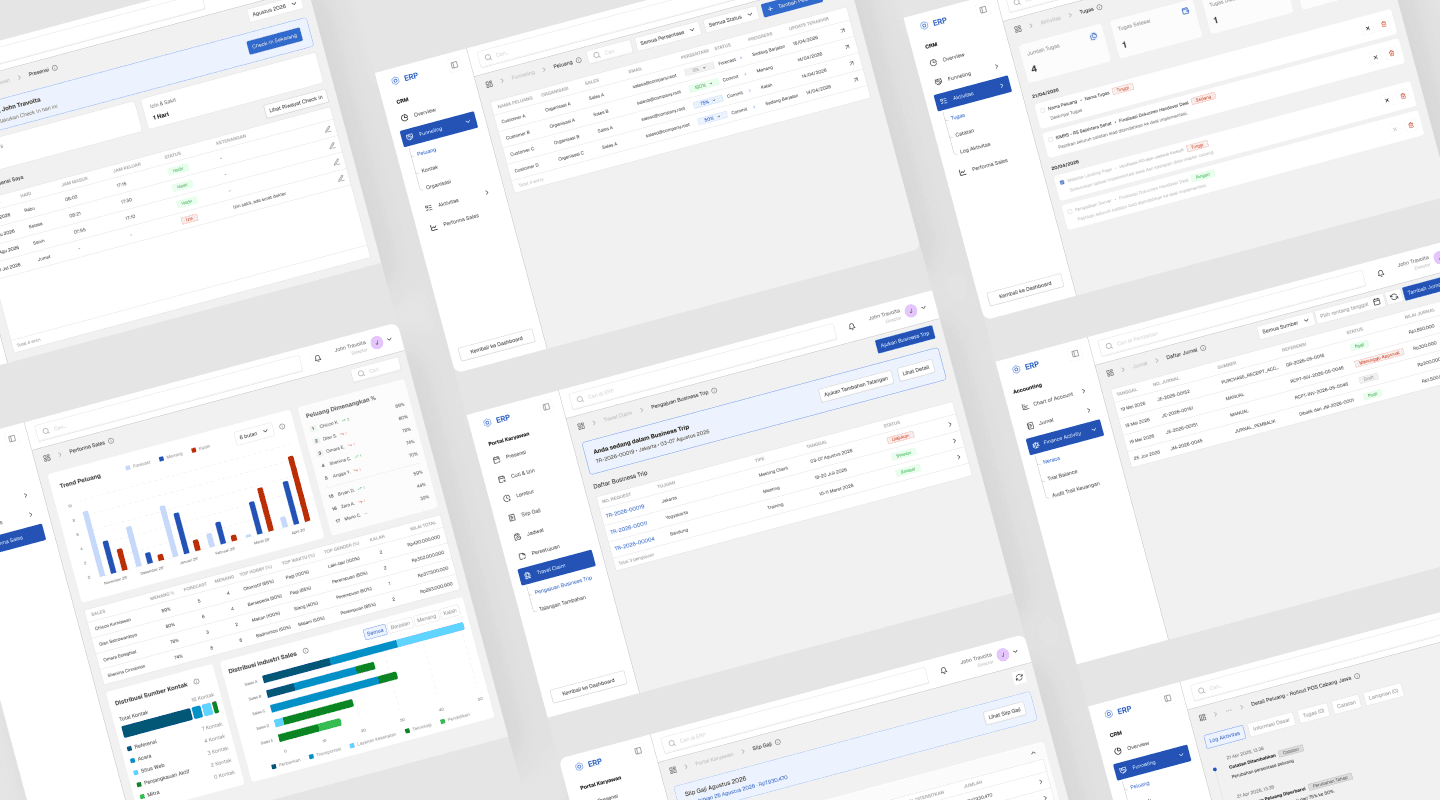
Aistech customized its ERP product for a technology solutions provider that wanted to bring its sales, purchasing, inventory, finance, and HR operations into one system. Five key customizations were built so the system would follow the client's way of working, namely three-party returns, the Employee Portal, payroll format, CRM, and journal rules. The result is a design of more than 550 screens across 11 modules, and starting October 2026 the CRM and Selling modules will be tested directly by the client's sales team before gradual integration with the other modules.
Aistech ERP Base Product
Aistech ERP is an integrated system that brings a company's operations together in one place. The base product covers employee management, CRM, sales, purchasing, inventory, accounting, finance, tax, and system administration, all in Indonesian and aligned with local regulations such as BPJS, PPh 21, and DJP reporting.
As a product, its foundation is designed to be connected from the start. Data entered in one module flows automatically to the others, for example a sale that immediately triggers delivery, invoicing, and then journal entries. This foundation is what gets customized to fit each client's way of working.
Client Custom Requests
The client is a technology solutions company that sells hardware, licenses, and services to a range of corporate and government clients. They requested five key customizations so the system would follow the workflows already running internally.
Three-party returns: a product return flow involving the customer, the company, and the original vendor in one recorded sequence.
Employee Portal: a self-service space for every employee covering attendance, leave and permission requests, overtime, payslips, shift schedules, and business travel, along with an approval inbox for managers.
Customized payroll format: a payroll calculation table that mirrors the structure of the payroll worksheet the HR and finance teams have always used.
Customized CRM: tracking of opportunities, contacts, and organizations that follows how their sales team builds relationships with customers.
Customized journals: journal recording, numbering, and correction rules that follow their internal accounting policies.
Problems and Solutions
Each request came with problems that typical ERPs rarely handle, because they grew out of the client's specific way of working.
Three-party returns
Products returned by customers are often defective from the factory. In many systems, returns stop between the customer and the company, so the cost of damage that could have been claimed from the vendor ends up being absorbed by the company.
The solution is that the return type, either refund or exchange, is chosen at submission with the Sales Order as the reference document. Once approved, the status changes to awaiting goods, since physical receipt is recorded by the warehouse. When the goods arrive, the warehouse marks whether the damage came from the vendor. If so, the claim is automatically forwarded to the purchase return flow to the vendor. If not, the cost is recorded as a company expense, making it clear which losses can be recovered and which cannot.
Employee Portal
Previously, leave, overtime, and business travel requests were mostly approved through quick messages with no record. Managers also tended to approve without reading the details, and HR had to recap everything manually.
The Employee Portal was built as a standalone module, separate from the HR module, so every employee can access it. Approval has two layers, first by the direct manager in the portal, then final approval in the relevant department's module such as HR or finance. Managers must open the request details before they can approve or reject. When a manager is on leave, they appoint an authorized substitute approver themselves, and payslips can only be opened after password verification.
Customized Payroll Format
The client's HR and finance teams were used to calculating payroll in a worksheet with more than 40 multi-level columns. It covered company and employee BPJS contributions, overtime calculations, prorated attendance and leave, THR, benefits in kind, and out-of-town accommodation. Forcing them into a generic format would mean making them relearn everything while opening the door to calculation errors.
The solution is a table that mirrors the structure of that worksheet. Identity columns such as name, position, employee ID, tax status, and length of service are frozen on the left, while the numeric columns scroll horizontally with two-level headers just like the original. Salary components can be calculated as fixed amounts, percentages, or formulas. A single payroll period can also hold several separate entries, for example monthly salary and THR. Finance disburses the funds in one go, and HR then distributes them per employee.
Customized CRM
The client's sales rely heavily on long-term personal relationships with decision makers on the customer side. CRMs generally only record transactions and sales stages, not the things that keep those relationships strong.
So contact data was enriched with family relationships, interests and preferences, and important dates such as the birthdays of contacts and their families. One organization can be both a customer and a supplier, and new organizations must be approved before becoming active. The sales performance dashboard also shows contact insights, such as the most common interests and interaction times, to help salespeople prepare a more personal approach.
Customized Journals
The client's accounting policy requires every correction to remain traceable. Recorded journals must not be changed silently, and journal numbers must show where each transaction came from.
Automatic journals from transactions are locked and can only be corrected through their source documents. For manual entries there is the Memorial Journal, with validation that debits equal credits, a minimum of two lines, and dates limited to open accounting periods. Drafts can be edited freely, but posted journals can only be voided with a required reason. When a journal is voided, the system automatically creates a reversing entry so the ledger stays balanced. Journal numbering differs by transaction source, account filters go down to the sub-account level, and reports can be exported to Excel.
Work Process
The work moved from the client's working documents to development-ready screens, with every important decision discussed before anything was drawn.
Exploring client documents and needs: the team studied payroll worksheets, financial report templates, and meeting notes for each module, then broke them down into a list of change requests per module.
Mapping flows before designing screens: complex flows such as three-party returns were mapped as flowcharts and iterated through three versions until everyone agreed.
Deciding cases one by one: ambiguous points were discussed together, such as which document serves as the return reference or when the return type is determined, so no assumptions carried over into development.
Designing screens with consistent patterns: screens were built with the same design system, and proven patterns were reused, such as sales returns following the structure of purchase returns.
Reviewing after building
every screen was reviewed again, revised when needed, and every decision was recorded in a continuously updated design document.
Cleaning up and auditing: all screens were audited for consistent naming, colors, and text styles, along with accessibility and UX writing reviews.
Handoff and phased testing: designs were handed off to the development team, then tested directly by users at the client, module by module.
Results and Output
The result is a complete ERP design with more than 550 screens across 11 modules, and the CRM and Selling modules are now entering testing with the client's sales team.
Three-party returns: a complete sales return flow from submission, approval, and receipt of goods at the warehouse to forwarding the claim to the vendor, along with its flowchart.
Employee Portal: seven self-service features for employees and five approval detail pages for leave, permission, overtime, shifts, and business travel.
Payroll format: a payroll table with 6 frozen identity columns and 43 calculation columns with two-level headers, mirroring the client's original worksheet.
CRM: richer contact and organization profiles, plus a sales performance dashboard with contact insights.
Journals: a Memorial Journal with draft, posted, and voided statuses, complete with automatic reversing entries.
In addition, screens in the audited modules are now consistent, so they're ready for further development without confusion over naming or visual style.
Next Steps
Starting October 2026, the client's sales team will test the CRM and Selling modules in their day-to-day work. Integration with the other modules will follow gradually, one at a time, so each division has time to adapt.
Feedback from this trial will be used to refine the system before the next module is rolled out. This phased approach keeps the client's operations running normally throughout the move to the new system.
