
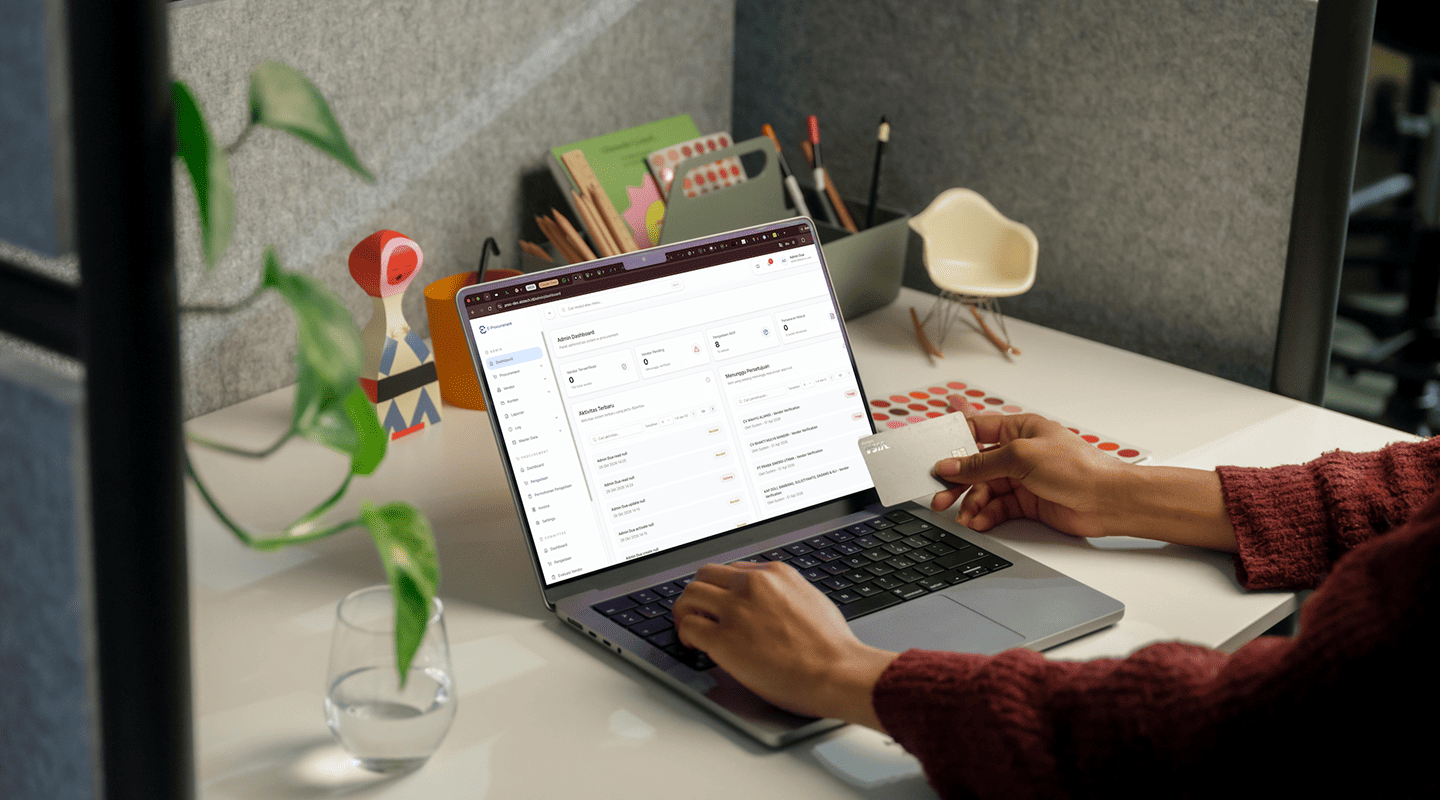
In many organisations, procurement still runs on a pile of emails, spreadsheets, and document folders that travel from desk to desk. Requests from business units wait days for signatures, invitations to vendors go out one by one, and bid documents arrive in all sorts of formats.
The consequences add up. Procurement committees struggle to keep every stage on schedule, leaders lack a complete picture of ongoing packages, and when auditors arrive the procurement team has to rebuild the decision trail from scattered sources. Vendors, meanwhile, lose certainty because they cannot tell where their process stands.
This Electronic Procurement System was built to bring order to that entire journey. From a purchase request raised by a business unit, through vendor selection, evaluation and contracting, all the way to a paid invoice, everything is recorded in one workflow that procurement staff, committees, approvers, auditors and vendors can follow according to their roles.
Public Portal and Vendor Registration
The system opens with a public portal that lists active tenders, news and announcements, public documents and a help page. Prospective partners can register right away through a four step form.
Company details, including legal entity type, business category, contacts and address.
Legal documents with validation of the NPWP (Indonesian taxpayer identification number), which must be active before the registration can be submitted.
Details of the PIC, the person in charge of communication.
Account details, where the company email automatically becomes the username and passwords must meet security standards.
Everything on the portal, from the homepage hero section, news and about page to image assets and incoming contact messages, is managed by administrators through a content module without touching any code.
Controlled Vendor Management
Every vendor has a complete profile covering company information, contacts, account and KBLI classification (the Indonesian Standard Industrial Classification). Verification is done per document group, so administrators know exactly which documents are complete.
Statement letters such as the Integrity Pact (Pakta Integritas) and a Non Disclosure Agreement, generated automatically from templates for vendors to complete.
Business licences, deeds of establishment, financial documents, technical documents and SMK3 (Indonesia's occupational health and safety management system certification).
Company profile and documents of the company's leadership.
Verified data cannot be changed at will. Vendors must submit a change request stating the reason, the section to be changed and its priority. Administrators then grant access and verify the changes. Problematic vendors can be blacklisted with a recorded reason, and the full vendor list can be exported to Excel.
Purchase Requisitions with Tiered Approval
Needs from business units start as a purchase requisition. The requester chooses between internal, routine external or non routine external procurement, selects goods, services or construction, picks a currency, then adds items with location, department, quantity, price and supporting documents.
The requisition then goes through tiered approval that can be configured by amount, for example from department head to manager and then to director. Approval progress is visible on every row, and approved requisitions can be selected in bulk and converted directly into e-Tender packages.
Procurement Packages and Scheduled Stages
Each procurement package has a detail page summarising its category, procurement method, evaluation method, estimated value, items, invited vendors, submitted bids, committee members and their positions, and the linked contract.
The system supports a range of methods, including open tender, limited tender, direct selection, direct procurement, direct appointment and request for quotation. Each method comes with a stage template and set durations, such as procurement invitation, registration, pre bid clarification meeting (known locally as aanwijzing), bid submission, evaluation, clarification and negotiation, minutes of results, announcement of the prospective winner, winner appointment and contract drafting.
The stage timeline shows completion percentages and flags late stages. Schedule changes can be made subject to approval, while committees track evaluations, meetings, negotiations and announcements on a dedicated calendar.
Measurable Bid Evaluation
Evaluation methods are built from three aspects, namely administrative, technical and commercial, with weights that can be set per method. Each aspect contains criteria with weights, scores and a mandatory flag.
Supports both pass or fail evaluation and weighted scoring.
Supports the two envelope system, in which administrative and technical aspects are assessed before the price envelope is opened.
Criteria can go down to specific documents such as business identification numbers, deeds, tax returns, work experience over the last three years, experts and equipment lists.
Bidders who disagree with the selection result can file an objection (sanggahan), which is then reviewed and decided by the authorised party within the system.
From Contract to Paid Invoice
Once a winner is appointed, a contract is drawn up with its number, period, value and winning vendor, complete with delivery milestones. The post contract flow runs in the same system.
Purchase orders, with a reversal mechanism when an order needs to be cancelled or corrected.
Goods receipt notes and goods receipts to record what was actually delivered.
BAST (Berita Acara Serah Terima, the official handover certificate) as proof that the work is complete.
Vendor invoices that go through approval, with their status tracked until they are rejected or paid.
Regular Vendor Performance Reviews
The relationship with a vendor does not end at the contract. Committees can design KPI templates for overall performance, delivery or quality, on a project basis or on monthly, quarterly or annual cycles. Contract ratings, vendor issues and rating approvals help organisations recognise which partners are worth keeping.
Official Documents Generated Automatically
The system keeps a library of document templates that can be filtered by type, such as pre bid meeting invitations and minutes, letters of winner determination, and electronic forms for the Integrity Pact and Non Disclosure Agreement. Templates are versioned, so format changes never erase the history of earlier documents. Administrators can also upload user manuals and decide which roles may access them.
Layered Access Control and Security
The system distinguishes between administrators, procurement staff, committee members, approvers, managers, directors, auditors and vendors. Access rights are highly granular.
Page level permissions to open, view, add, edit and delete.
Cross module features that can be granted to specific users without giving them an entire extra role.
Access policies down to individual API endpoints, plus a navigation menu managed directly from the database.
Multi factor authentication through email OTP, authenticator apps, approval from another signed in device, and passkeys.
Administrators can sign in as another user to help trace an issue, and every such session is still logged.
Audit Trail and Reporting
Activity logs are kept separately for users, vendors and procurement. Each entry records the time, action type, user, IP address and details of the changed data, can refresh live, and can be filtered by action, type and date range.
The reporting and analytics module presents summaries, trends, vendor analysis, categories and performance, with filters for date range, category and status, ready to export for management or audit purposes.
Well Organised Master Data
Procurement categories, methods, currencies, units of measure, material and service groups, procurement teams, organisational units, positions and a product catalogue with item codes are all managed in one place. This consistent master data is what keeps every requisition, package and report neatly connected.
What Sets It Apart
1. A complete procurement cycle. Requisitions, vendor selection, evaluation, contracts, goods receipt, handover certificates and invoices all run in one system without switching applications.
2. Stages that follow organisational guidelines. Procurement methods and stage templates with their durations can be configured to match each organisation's internal rules.
3. Transparent and measurable evaluation. Administrative, technical and commercial weights are clearly defined, with support for the two envelope system and formal objections.
4. Official documents without retyping. Invitations, minutes, winner determination letters and integrity pacts are generated from versioned templates.
5. Layered security. Multi factor authentication, passkeys and fine grained access control down to the endpoint level protect sensitive procurement data.
6. Accountability you can prove. Every action is logged with the user, time, IP address and the data that changed.
7. Vendors managed across the whole relationship. Document verification, controlled data changes, KPI reviews and blacklisting live in one place.
8. A self managed public portal. Announcements, news and homepage content can be updated by administrators at any time through the content module.
Closing
Good procurement is not only about securing the best price. It is also about a process that is fair, on schedule and accountable. This Electronic Procurement System places every party in the same workflow, so every decision has a basis and every document has a home.
For organisations ready to leave manual processes behind and keep their procurement audit ready at all times, this system offers a complete foundation that is still flexible enough to adapt to the guidelines they follow.
