Ideal vs. Reality
Ideally, a company runs like a single body. The moment the sales team closes a deal, the warehouse knows which goods to prepare, finance knows when the invoice will come in, and HR knows who deserves recognition. Every decision is made from the same data, and no one has to ask twice about numbers that should already be clear.
The reality is very different in many mid-sized companies in Indonesia. Attendance is recorded in one app, salaries are calculated in spreadsheets with formulas that break easily, leave requests go through a quick text to a manager, and stock levels are only known after someone walks down to the warehouse. Every division has its own version of how the company is doing, and bringing them together takes meetings, manual recaps, and a lot of time.
The Problem
The main problem isn't a lack of apps. It's too many apps that don't talk to each other. Scattered data lets small mistakes travel far. One typo in a payroll spreadsheet can lead to the wrong BPJS deduction, and one unrecorded product return can throw off both the stock report and the financial report.
The second problem is approvals that leave no trail. When leave, overtime, or travel claims are approved over chat, the company loses track of who approved what and when. That makes audits harder and opens the door to misunderstandings between employees and their managers.
The third problem is that many available ERPs were designed for other countries. The terms feel foreign, the tax rules don't fit, and the workflows are forced onto companies that work differently.
So the question becomes simple. How can a company in Indonesia run all of its operations from a single source of data, with workflows that match the way it actually works, without having to learn a system that feels foreign?
The Solution
Aistech ERP solves this by bringing every business process into one connected system. When the sales team creates a Sales Order, that data flows to the warehouse for delivery, then to invoicing, then to the financial records, with no need to re-enter it anywhere else.
Every request leaves a clear trail. Employees submit leave, overtime, or business travel requests through the Employee Portal, managers approve them from the same approval inbox, and each decision is recorded along with its time and reason. Managers also have to review the request details before approving or rejecting, so decisions are never made with a careless click.
The system is also built with the language and regulations Indonesian companies know. Payroll already accounts for BPJS Ketenagakerjaan and BPJS Kesehatan (national employment and health insurance), overtime, THR (the annual holiday allowance), and PPh 21 (employee income tax), while the tax module prepares reporting to DJP (the Directorate General of Taxes). As a result, teams can focus on work that matters instead of reconciling numbers between divisions.
Features by Module
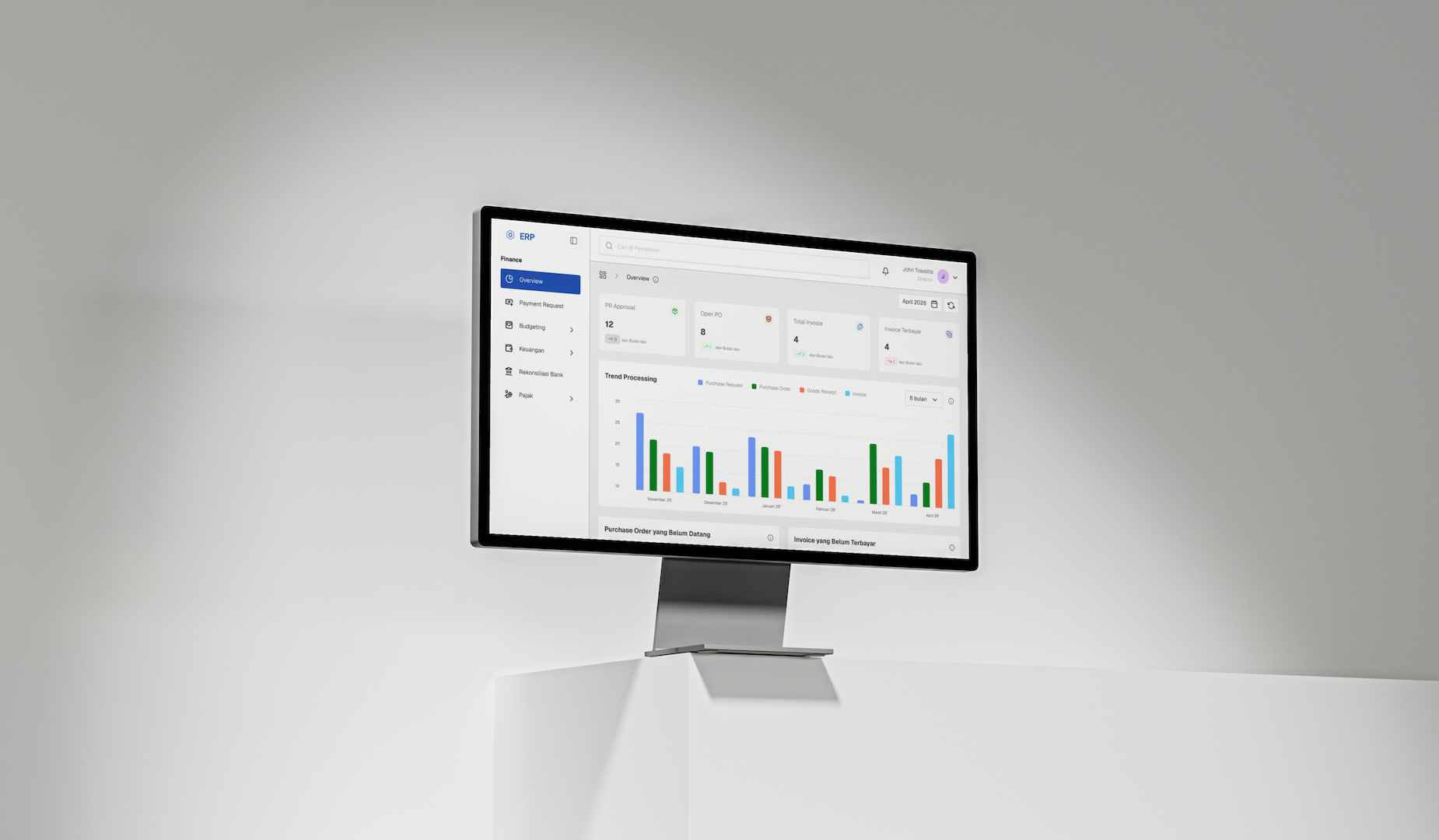
Aistech ERP consists of ten main modules, all accessible from a single dashboard.
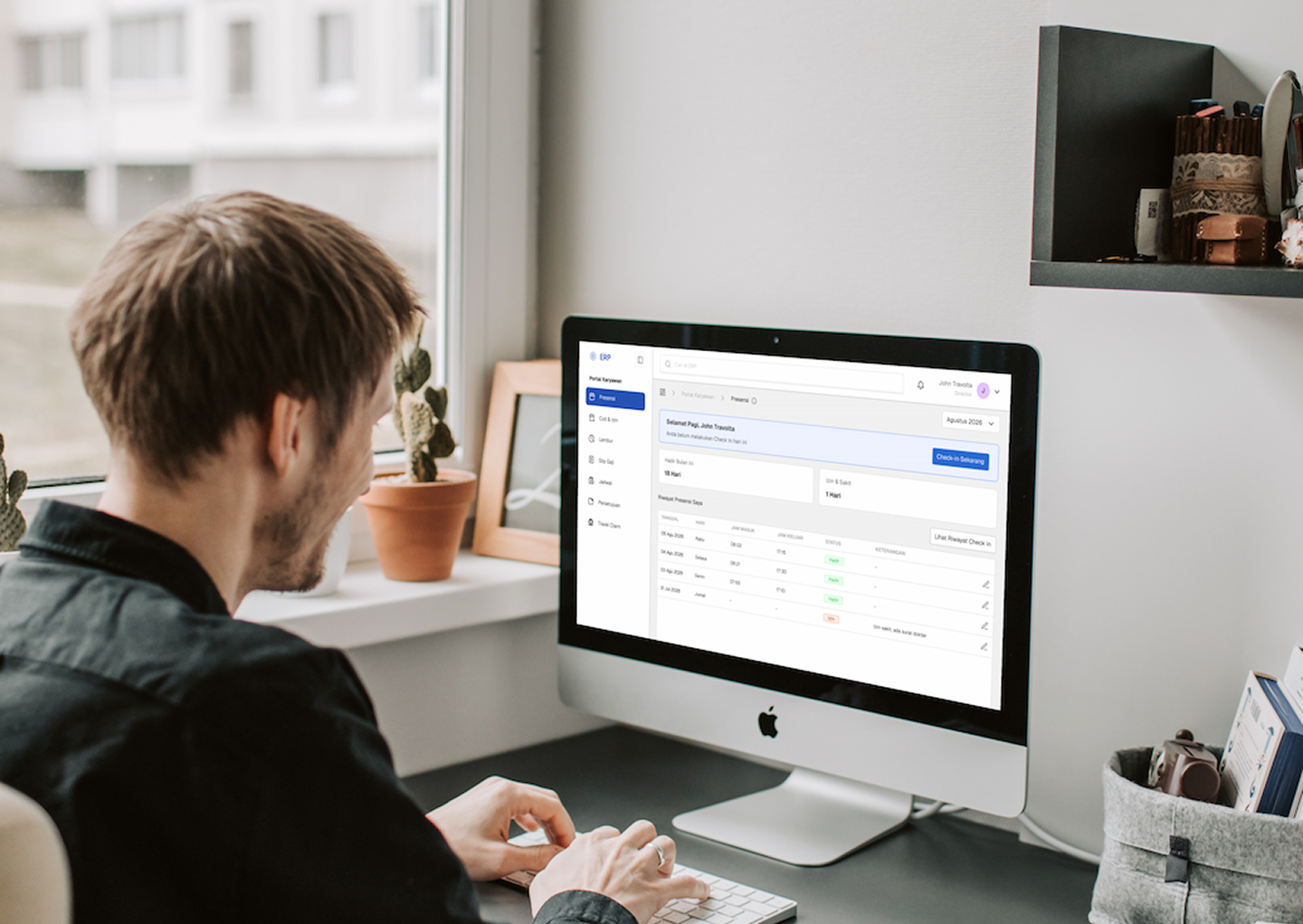
Dashboard. The first page after logging in, with a daily check-in button, a monthly check-in history, shortcuts to every module, and a list of recently opened pages so users can pick up right where they left off.
Employee Portal. A personal space for every employee across all divisions. Here employees can view their attendance, submit and cancel leave or permission requests, submit overtime with supporting proof, open password-protected payslips, view shift schedules, request business travel and cash advances, and approve their team's requests from a single approval inbox.
Human Capital. The module HR uses to manage the full employee lifecycle. It covers employee data and contracts, onboarding and offboarding including asset and access handover, attendance and shifts, leave, business travel, and payroll with salary components that can be calculated as fixed amounts, percentages, or formulas. It also includes a manager for official company letter templates.
CRM. A tool that helps the sales team manage business opportunities from the very start. It includes management of opportunities, contacts, and customer organizations, task and activity tracking, and a sales performance dashboard showing opportunity trends and each salesperson's win rate.
Selling. Handles the sales flow from Quotation, Sales Order, and Delivery Order through to Return Order. Returns here support three parties, the customer, the company, and the vendor, so factory defects can be claimed back from the vendor. The invoicing section covers sales invoices, payment history, and receivables aging.
Buying. Handles the purchasing flow from Purchase Request, Purchase Order, and Goods Receipt through to Goods Return to the vendor. It also covers vendor invoices, payment requests, payment terms, and bills.
Inventory. Records items and warehouses, current stock, stock movement history, incoming and outgoing goods including returned items, stock reconciliation, and asset depreciation.
Accounting. Holds the chart of accounts, general journal, memorial journals that can be saved as drafts, posted, or voided, accounting periods, general ledger, balance sheet, trial balance, and a financial audit trail.
Finance. Manages money going out and coming in. Vendor payment requests, payroll, and employee claims are gathered in one place, each with an unpaid, partially paid, or paid status. The module also covers budgeting per cost center, account balances, expense summaries, profit and loss statements, bank reconciliation, and tax reporting to DJP.
Administration. The system's control center. Admins can manage user accounts, create roles with detailed per-module access rights, configure notification channels and templates via email or phone number, and monitor activity logs for every user.
What Makes It Different?
First, Aistech ERP was born in an Indonesian context, not translated into one. The interface is fully in Indonesian, and the regulations that cause the most headaches, like BPJS, PPh 21, THR, and DJP reporting, are part of the core system rather than add-ons installed separately.
Second, employees are more than data entries. Many ERPs only give access to HR and management, while in Aistech ERP every employee has their own Employee Portal to take care of their own needs. HR's administrative load gets lighter because requests arrive complete and well organized from the start.
Third, the workflows follow how work really happens, including the cases that often get overlooked. Examples include three-party returns when a customer's defective item turns out to come from the vendor, or cancelling leave that was already approved but still needs re-approval. In other ERPs, cases like these are usually handled outside the system.
Fourth, Aistech ERP is developed by a team experienced in building complex operational systems, from academic information systems and hospital information systems to eProcurement. The approach is a ready-to-use product that stays open to customization when a client's needs are truly different.
Who Is It For?
Aistech ERP is best suited for mid-sized companies and institutions in Indonesia whose operations already span many divisions but still rely on spreadsheets and separate apps to run them.
Distribution, trading, and technology solution companies will benefit the most, because their sales, purchasing, stock, and return flows depend on each other every day. Organizations with a large workforce are also a great fit, especially those with shifts, overtime, and regular business travel, since the Employee Portal and Human Capital module cut down on repetitive administrative work.
In terms of roles, the system serves almost everyone in the company. Leadership gets a complete picture for decision making, the HR, finance, accounting, sales, and warehouse teams work from the same data, and every employee can take care of their own needs without going back and forth asking questions. For companies that want to grow without growing their administrative complexity, Aistech ERP is the right foundation to start with.
